You Can See Everything. Except, Apparently, You Can’t.
On Nathan Fielder’s wonderfully strange brain, the theater experience, and what a documentary about Elizabeth Holmes taught me about reading people.

I walked into the legendary Village East Cinema in New York thinking I was about to watch a documentary about Elizabeth Holmes.
Almost three hours later, I walked out thinking about Billy Evans, Nathan Fielder, human behavior, and how little we actually know about the people sitting across from us.
I love this shit.
For anyone unfamiliar, You Can See Everything is an A24 documentary directed by Nathan Fielder and Lance Oppenheim. Elizabeth Holmes, the disgraced Theranos founder, invites a film crew into her home in the weeks before she goes to prison.
The premise sounds fairly straightforward.
It is absolutely not.
And I really don’t want to spoil it because part of the pleasure is watching the whole thing become increasingly bizarre.
But I do want to talk about what stayed with me.
First, Nathan Fielder. What a wonderfully strange brain.
I have such a soft spot for people who see things differently.
Not necessarily the loudest person in the room. Not the person with the most impressive credentials. But the person who notices something the rest of us missed, gets curious, and follows that curiosity somewhere completely unexpected.
Nathan is one of those people.
His particular genius, I think, is his willingness to sit inside discomfort longer than most of us can tolerate.
He doesn’t rush to fill the silence. He lets the awkwardness develop. And sometimes, just when you’re wondering whether anything is happening, somebody reveals something extraordinary.
It’s funny. It’s uncomfortable. Occasionally, it’s so absurd you wonder whether you’re being played.
Which, of course, is part of the point.
And credit to Lance Oppenheim too. The filmmaking is incredibly deliberate. What the camera shows, what it withholds, and how long it stays with someone all become part of the story.
I’m fascinated by the amount of trust it takes to make something this unconventional, especially when the audience might not immediately understand what you’re trying to do.
I hope the Academy gives this film serious consideration for Best Picture. No documentary has ever been nominated in that category.
Wouldn’t it be wonderful if this strange, nearly three-hour experiment became the first?
The thing about reading people
I spend a lot of time around dinner tables.
Through First Seating, I bring together chefs, founders, investors, and people from very different worlds. A large part of my work is understanding people and figuring out who might genuinely enjoy, challenge, or help one another.
And I’ve learned that you can know someone’s entire résumé and still know very little about them.
Sometimes you learn more from watching how they treat the person pouring their water.
Or whether they interrupt someone.
Or what happens when another guest disagrees with them.
A dinner party is an interesting place because everyone is, to some extent, performing.
We’re choosing what stories to tell. Which parts of ourselves to reveal. How we want to be understood.
Hospitality adds another layer to this.
A great host can make you feel completely at ease without you noticing how carefully the experience has been arranged.
The seating. The pacing. The introductions. Even the pauses.
The room has been designed, but the emotions happening inside it are real.
Watching this documentary, I kept thinking about that distinction.
Elizabeth wants to be seen a certain way. Billy has his own relationship with how she is seen. Nathan arrives trying to understand them, but he isn’t exactly a neutral observer either.
And then there’s us, the audience, watching a version of reality that has already been shaped by someone else.
Everybody is observing. Everybody is interpreting. And everybody has a blind spot.
What I couldn’t stop thinking about was Billy.
One of the most interesting things about the film is Nathan’s apparent instinct to protect Elizabeth from Billy.
The more he observes their relationship, the more his perception of Billy seems to influence how he interprets Elizabeth.
But isn’t that fascinating?
The person trying to uncover someone else’s blind spots might be developing his own.
I found myself wondering how much of what I was watching was actually happening between these people, and how much was being shaped by Nathan’s interpretation of it.
Especially that final swimming scene.
I won’t spoil it, but it made me reconsider how much of their dynamic we had really been allowed to see.
And then I started questioning my own interpretation.
Was I seeing something that was genuinely there? Or had the film simply become very good at teaching me where to look?
I don’t think those are necessarily the same thing.
And perhaps this is why I loved watching it in a cinema.
I’m glad I tagged along with my husband Jonah to Village East.
There was something amusing about watching a documentary about Elizabeth Holmes in a room full of First Round founders, operators, and tech bros, with Josh Kopelman offering a disclaimer before the screening.
Practically a Silicon Valley reunion in NYC, just with a little more hindsight ;)
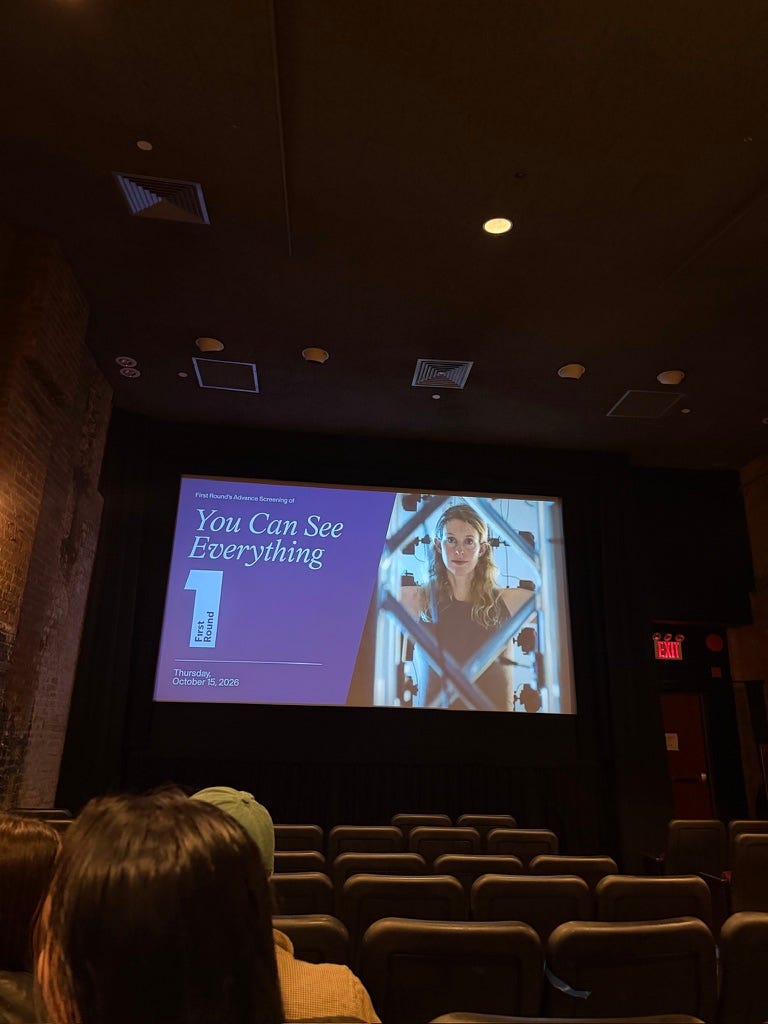
The collective reactions made it even better. Some people laughed, others went quiet, and I found myself wondering how differently everyone was interpreting the exact same scenes.
It reminded me of hosting dinners.
Eight people can sit around the same table, eat the same food, have the same conversations, and leave with eight completely different versions of what happened.
Same room. Same people. Different experiences.
That’s what fascinates me about both cinema and hospitality. You can bring people together and carefully shape an experience, but you can’t control what they take away from it.
Being present for something doesn’t necessarily mean we’ve understood it.
I don’t think being perceptive makes you immune to being wrong.
This is probably the part I’m sitting with most.
I’ve spent much of my life being very attentive to people. Reading expressions, picking up on changes in tone, noticing what isn’t being said.
For a long time, that attentiveness was useful because it helped me anticipate what might happen next.
And it has certainly helped me professionally.
But I’m also learning that noticing something and understanding it are two different things.
Sometimes an observation is just an observation.
You can be incredibly good at reading a room and still misunderstand the person in it.
You can spot a pattern and be wrong about what caused it.
And you can become so attached to your own interpretation that you stop being curious.
That’s the danger, isn’t it?
The moment you believe you’ve figured someone out, you might stop paying attention.
Anyway, I hope this film makes history.
I love discovering exceptional talent, especially when someone is doing something that doesn’t fit neatly into an existing category.
It’s a huge part of why I work with chefs.
There’s something exciting about witnessing someone with a very particular point of view develop it into a body of work that feels unmistakably theirs.
Not everything has to appeal to everyone.
Not every creative decision needs to be explained immediately.
Sometimes the most interesting work comes from someone being just stubborn enough to follow an idea that sounds completely ridiculous to everybody else.
And Nathan Fielder is quirky AF. I mean that with enormous affection.
I love his brain.
I love that Lance and Nathan made something this strange.
And I love that I left the cinema without a neat conclusion.
Actually, I have one.
The more interesting people become, the less interested I am in pretending I’ve figured them out.
Maybe that’s a good thing.
Anyway, please go watch You Can See Everything in a theater if you can.
And then come back and tell me what you thought of Billy.
Because I have QUESTIONS.
Comments